A vending machine business earns revenue by placing automated retail equipment where people want convenient access to products. Starting one involves more than buying a machine: you need to research demand, secure a location, meet local rules, select inventory, and track costs and sales. The U.S. Census Bureau’s 2022 Economic Census counted about 19,700 businesses in the U.S. vending machine operators industry, illustrating an established but competitive market. This guide explains how to assess the business model, choose a profitable location and machine, handle permits and operations, and evaluate realistic startup economics.
Vending machine business fundamentals and business models
A vending machine business is a retail operation that sells goods through automated equipment, usually at locations the operator does not own. The U.S. Census Bureau classifies vending machine operators under NAICS 454210, a category covering operators that sell merchandise through vending machines they own or operate. The business can be run independently, as a route-based operation, or through a franchise or machine-placement arrangement.
The basic commercial relationship has three parts: the operator supplies and services the machine, the property owner provides access to a site, and customers purchase the products. Revenue is not the same as profit. Product costs, location commissions, payment processing, fuel, repairs, insurance, taxes, and the cost of the machine all affect what remains.
Common vending business types
A vending business can specialize in traditional snacks and beverages, fresh or frozen food, coffee, personal-care items, electronics accessories, or niche products such as protective equipment. The right category depends on who visits the site, when they need a product, storage conditions, and applicable regulations. For example, a factory with overnight shifts may support drinks and filling snacks, while a hotel may have demand for toiletries and travel essentials.
Traditional machines can be simpler to operate than refrigerated or specialized units, but product variety alone does not create demand. Choose products based on observed customer needs and sales data, then adjust the mix as purchasing patterns become clear.
Independent operator, franchise, or placement arrangement
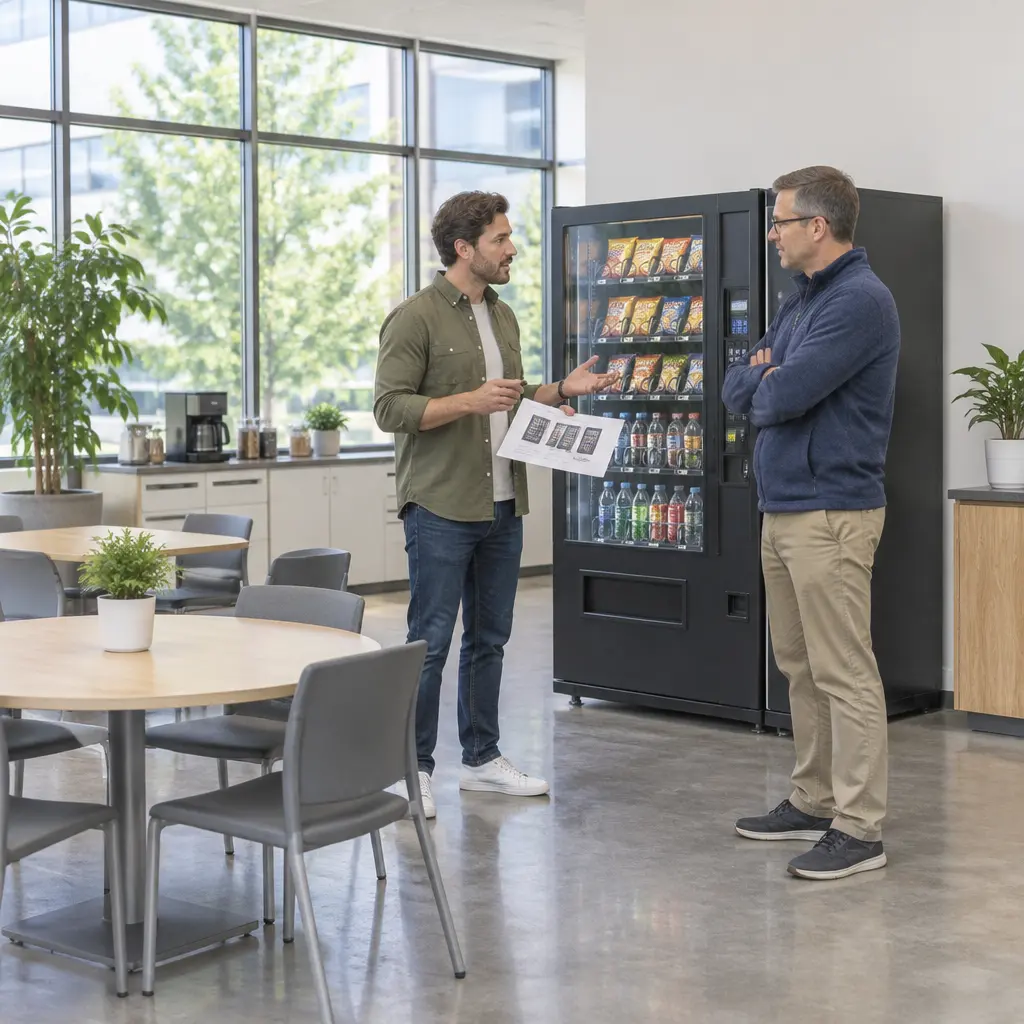
An independent operator chooses equipment, products, suppliers, and locations. This offers flexibility but requires the owner to find sites, negotiate terms, handle servicing, and build operating procedures. A franchise may provide branding, training, or supplier relationships in exchange for fees and compliance with its rules; review the franchise disclosure document and contract carefully before paying.
In a placement arrangement, another company may install or manage the machine while the property owner receives a commission or other benefit. Clarify who owns the equipment, stocks it, collects revenue, responds to breakdowns, and bears liability. Regardless of model, verify sales claims independently and do not treat projected revenue as guaranteed.
Vending machine location selection and site agreements
A vending location is the physical site where a machine is installed and offered to customers. Its value depends on relevant foot traffic, customer dwell time, purchasing need, competition, accessibility, and operating conditions—not simply the number of people who pass by. A smaller workplace with repeat users may outperform a busy site where people move quickly and have other convenient options.
The National Automatic Merchandising Association (NAMA) describes the industry as serving workplaces and public settings with convenient access to food and other goods. For a new operator, the practical lesson is to evaluate each location as a distinct retail opportunity and estimate demand before committing to equipment or inventory.
How to assess demand before choosing a site
Start by identifying the likely customer and the problem the machine solves. Observe traffic at different times and days, ask the property manager about employee or visitor counts, and note nearby cafés, stores, break rooms, and competing machines. Check whether customers can reach the machine during the hours it is stocked and whether the site has suitable power, connectivity, lighting, and security.
A useful site assessment records expected customer volume, operating hours, product fit, competitor availability, access for restocking, and any restrictions on food or beverages. Treat estimates as assumptions to test. A pilot period or sales-based agreement can limit risk when the site’s demand is uncertain.
Negotiating a location agreement
A location agreement sets out the operator’s rights and responsibilities and the property owner’s compensation. Common arrangements include a fixed rent, a percentage of sales, or no fee where the service itself is valuable to the site. Compare the full cost of each arrangement: a sales commission can reduce margins, while fixed rent can become burdensome when sales are slow.
Put key terms in writing, including the placement area, contract length, renewal and termination rights, commission calculation, electricity responsibility, access hours, service response expectations, insurance requirements, exclusivity, and ownership of the machine. Define whether “sales” means gross receipts or excludes refunds, sales tax, and payment fees. Have a qualified local professional review the agreement when the financial commitment or liability is significant.
Vending machine equipment, inventory, and technology
The machine and its supporting technology determine what the business can sell, how reliably it operates, and how much time the owner spends servicing it. Match equipment to the products and site rather than buying based only on price or advertised capacity. A used machine may reduce upfront spending but could require repairs, lack modern payment features, or have limited parts availability.
Selecting and purchasing a machine
Compare machine type, capacity, dimensions, power requirements, temperature control, accessibility, payment compatibility, warranty, and serviceability. Refrigerated equipment requires additional attention to temperature monitoring and food safety. Before purchasing used equipment, inspect its condition, test every selection and payment method, check the model’s parts availability, and confirm that it can be transported and installed at the intended site.
The U.S. Department of Justice’s 2010 ADA Standards for Accessible Design include requirements for operable parts of certain vending machines, including reach and operating features. Requirements can depend on the machine, installation, and applicable law. Check current federal, state, and local accessibility rules and consult a qualified professional rather than assuming that a particular machine or location is compliant.
Product selection, pricing, and replenishment
Inventory is the set of products offered for sale. Start with a focused assortment that fits the site, then review sales by product, time period, and machine. Consider purchase cost, selling price, expiration dates, storage needs, product popularity, and the risk of spoilage. A machine that sells fresh food has different handling, temperature, and replenishment needs from one selling shelf-stable snacks.
Set prices using the landed product cost plus a contribution toward commissions, payment fees, route expenses, repairs, and overhead. Check local market prices and any restrictions imposed by the site or law. Use inventory records to identify products that sell quickly, sit too long, or repeatedly go out of stock; revise the assortment instead of assuming every product deserves a permanent slot.
Cashless payments and remote monitoring
Cashless payment systems allow customers to pay by card or compatible mobile methods, while telemetry systems can report sales, stock levels, and machine status remotely. These tools may reduce unnecessary service visits and help prevent lost sales from empty selections, but they add equipment, connectivity, and transaction costs. Confirm processor fees, settlement timing, contract terms, data access, and compatibility before signing up.
A practical comparison chart can show each machine’s purchase cost, capacity, payment options, refrigeration, warranty, and monthly technology fees. Compare total ownership cost—not just the sticker price—and verify that reported sales reconcile with payment processor statements and physical inventory.
Vending business registration, permits, and food safety
Legal requirements depend on where the business operates, what it sells, and how it is structured. Before installing a machine, check federal, state, county, and city requirements for business registration, tax collection, vending permits, food establishment licensing, zoning, and machine-specific rules. The U.S. Small Business Administration emphasizes that license and permit requirements vary by business activity and location.
Business structure, tax registration, and permits
Choose an appropriate business structure, register the business name where required, and obtain an employer identification number if applicable. Ask the relevant state and local tax agencies whether sales tax applies to the products and transactions involved, how vending sales must be reported, and whether each machine or site requires a separate permit. Keep records of sales, purchases, fees, mileage, and maintenance for tax and financial reporting.
Requirements can differ even between neighboring municipalities. Contact the local licensing office, tax authority, and health department before buying equipment or signing a long-term site contract. Do not rely on a vendor’s general statement that a machine is “permit-free” without confirming the rules for your location and products.
Food safety and product handling
Food safety covers the conditions and practices needed to prevent food from becoming unsafe. The U.S. Food and Drug Administration’s Food Code is a model used by jurisdictions as they develop food safety rules; local adoption and requirements vary. Operators selling perishable food should ask the local health authority about licensing, temperature control, equipment standards, cleaning, labeling, and inspection requirements.
Use suppliers that provide reliable product and date information, rotate stock using first-in, first-out practices, remove expired or damaged products, and keep service and temperature records where required. If a machine sells only packaged, shelf-stable goods, rules may differ, but the operator should still verify local requirements rather than assume an exemption.
Vending machine startup costs, profitability, and financing
Startup costs include the machine, transport and installation, initial inventory, payment hardware, permits, insurance, business formation, and working capital. Continuing costs include restocking, commissions, processing fees, fuel, repairs, spoilage, utilities where applicable, taxes, and financing. Because costs vary by equipment and location, build a budget from supplier quotes and written site terms rather than relying on generic claims about easy or guaranteed profits.
Build a break-even and cash-flow estimate
Break-even analysis estimates the sales needed to cover costs. For each machine, calculate expected monthly sales, subtract product costs and sales-linked expenses, then account for fixed costs and the machine’s purchase or financing cost. Separate one-time setup spending from recurring expenses, and model a conservative case in which sales are lower than expected or repairs take the machine offline.
For example, if monthly sales are $1,000 and the combined product cost, location commission, and payment fees total $650, the remaining $350 is not automatically profit. It still has to cover route labor, fuel, insurance, repairs, taxes, financing, and other overhead. This example is illustrative, not a forecast; actual results depend on the products, prices, location, and operating costs.
The U.S. Bureau of Labor Statistics reports economy-wide producer price data that can help operators understand that input costs change over time, but it does not publish a guaranteed profit rate for an individual vending machine. Review supplier prices and your own sales records regularly. A simple chart comparing monthly revenue, product costs, commissions, processing fees, and operating expenses can make weak locations visible early.
Funding and financial controls
Funding may come from personal savings, a business loan, equipment financing, or other sources. Compare interest, fees, collateral, repayment schedules, and restrictions, and avoid borrowing on the assumption that a machine will produce a particular return. Keep a reserve for repairs and replenishment so that a temporary sales dip does not prevent the business from servicing a promising location.
Use a dedicated business bank account and reconcile cash, card receipts, refunds, and inventory purchases. Track each machine separately where possible. Per-machine records help distinguish a genuinely profitable site from one whose sales are being masked by the performance of other locations.
Vending route operations, maintenance, and growth
A vending route is the planned sequence of machines an operator visits to restock, clean, inspect, and repair. Efficient route management balances product availability with travel time and service labor. Poorly planned routes can consume the margin of otherwise healthy machines, especially when locations are spread across a wide area.
Restocking, service, and customer response
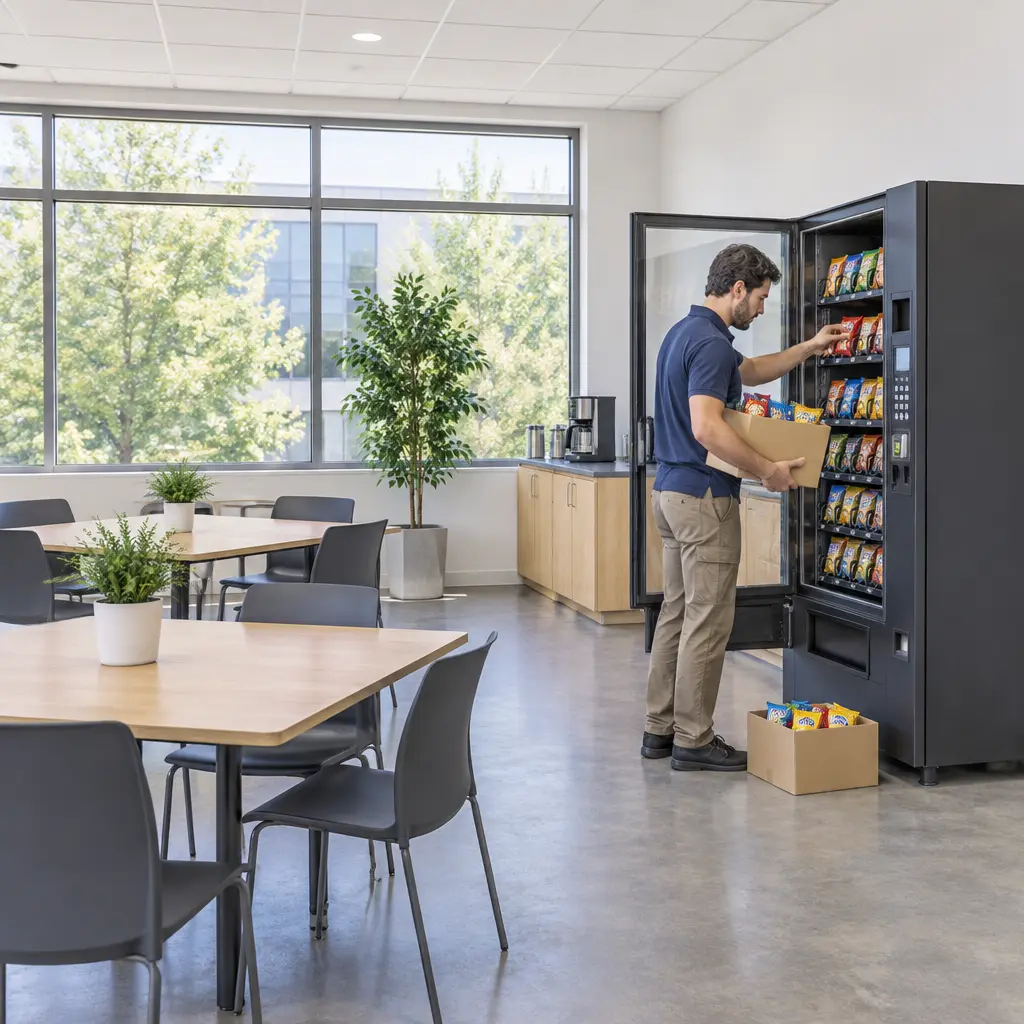
Set service frequency according to sales velocity, product shelf life, machine capacity, and site access. Use sales and inventory records to bring the right stock, inspect payment and dispensing systems, clean surfaces, remove expired products, and document issues. Provide a clear way for customers or site managers to report failed transactions, outages, or product problems, and define how refunds will be handled.
Preventive maintenance can include checking refrigeration, seals, coin and bill mechanisms, card readers, coils, doors, and electrical connections. Follow the manufacturer’s instructions and use qualified technicians for work that requires specialist knowledge. Keep records of breakdowns and response times so recurring failures can inform repair or replacement decisions.
Scaling from one machine to a route
Grow by validating one location before adding equipment and obligations. Confirm that the first machine’s sales cover its direct costs, that the site is satisfied with service, and that restocking is manageable. Then add nearby sites with compatible products and service schedules, which can improve route efficiency without assuming that every new placement will perform like the first.
A useful operating dashboard tracks sales per machine, gross margin, stockouts, spoilage, service visits, downtime, refunds, and location fees. Review the figures monthly and renegotiate, relocate, or remove machines that consistently fail to justify their costs. Expansion should follow measured performance and dependable cash flow.
Conclusion: Start a vending machine business with evidence
Starting a vending machine business means combining a suitable business model with a validated location, reliable equipment, well-chosen inventory, compliant operations, and disciplined financial tracking. The industry is established, but an individual machine’s results depend on its customers, site agreement, product economics, and route costs—not on broad industry averages or promotional income claims.
Before investing, speak with prospective site owners, check local licensing and food rules, compare equipment and payment costs, and prepare conservative break-even estimates. Start with a manageable pilot, measure actual performance, and expand only when the numbers and service workload support it. For further research, consult your local health and licensing agencies, the SBA, NAMA, and the relevant equipment and payment-system documentation.
Sources: U.S. Census Bureau, 2022 Economic Census, NAICS 454210, Vending Machine Operators, https://www.census.gov/programs-surveys/economic-census.html; National Automatic Merchandising Association, Industry Resources, https://www.namanow.org/; U.S. Small Business Administration, Apply for Licenses and Permits, https://www.sba.gov/business-guide/launch-your-business/apply-licenses-permits; U.S. Department of Justice, 2010 ADA Standards for Accessible Design, https://www.ada.gov/law-and-regs/design-standards/2010-stds/; U.S. Food and Drug Administration, 2022 Food Code, https://www.fda.gov/food/retail-food-protection/fda-food-code; U.S. Bureau of Labor Statistics, Producer Price Indexes, https://www.bls.gov/ppi/.