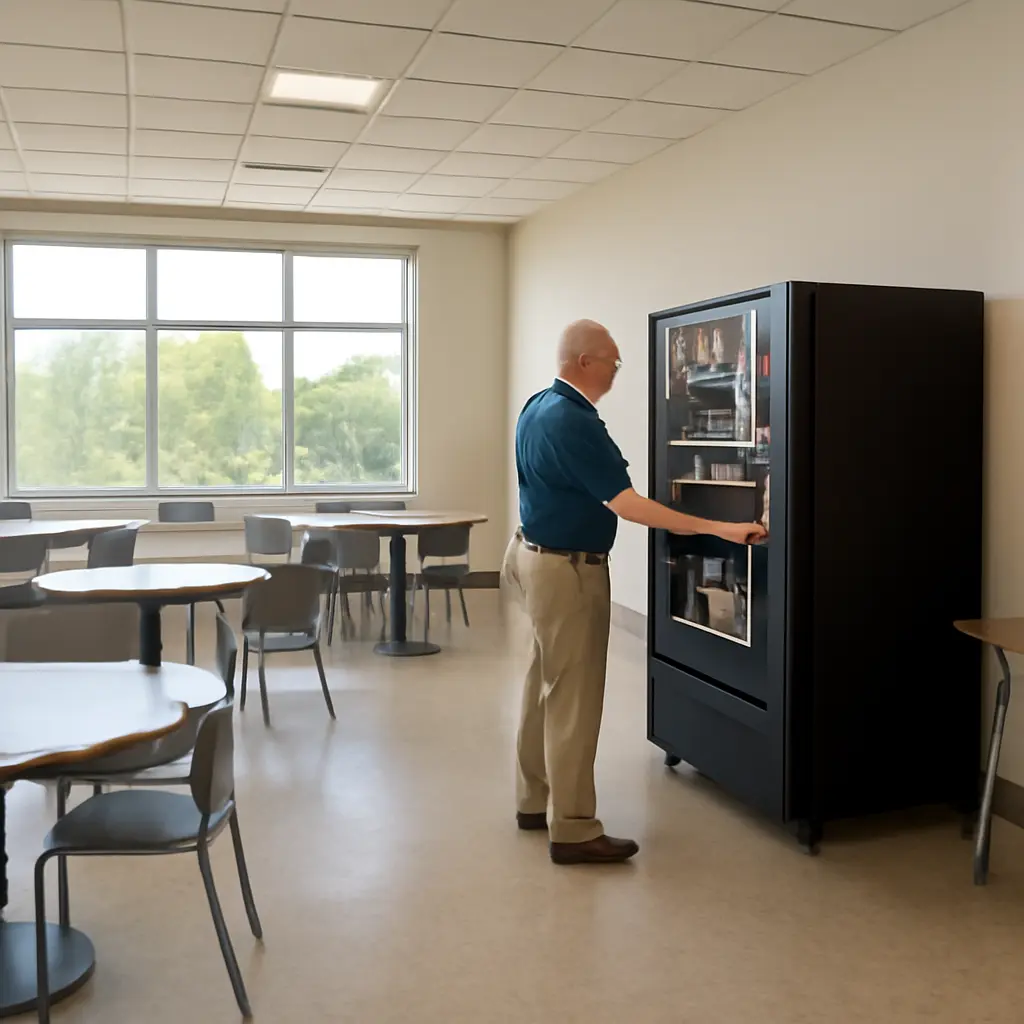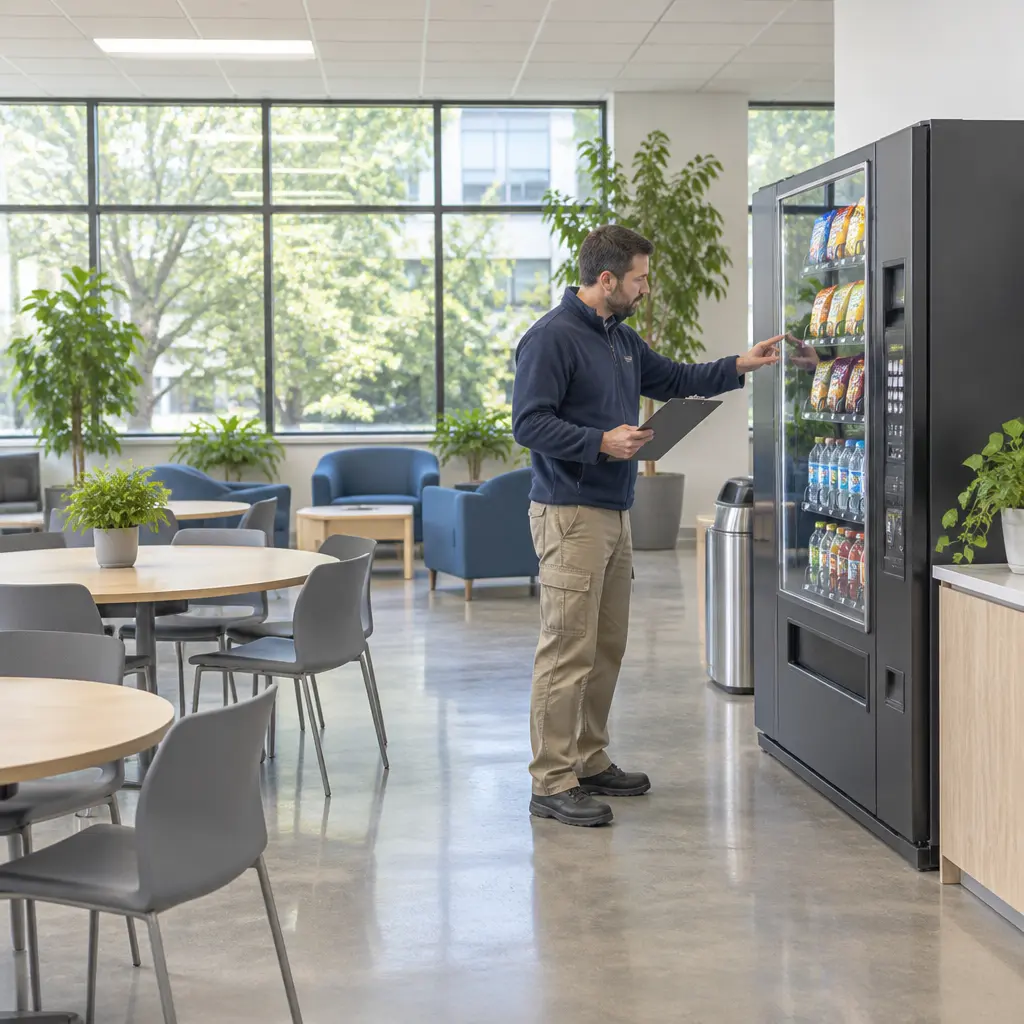
A vending-machine location is a specific workplace, school, hospital, apartment complex, or public venue where people can buy unattended goods. The right number of machines depends less on a fixed headcount rule than on how many people use the site, when they are present, what they want to buy, and how far they must travel to reach a machine. As a practical starting point, one well-stocked machine may serve a small site or a single convenient area; larger, round-the-clock, or spread-out locations may need multiple machines or service points. This guide explains how to estimate demand, choose machine types, account for layout and operating costs, and refine the count using sales data.
Vending machine quantity depends on location demand and access
There is no universal vending-machine-per-person standard that reliably applies to every location. The National Automatic Merchandising Association (NAMA) describes vending as a retail channel whose performance depends on the consumer, product mix, and operating environment; its industry research tracks sales and consumer behavior rather than prescribing a single machine-to-population ratio. In practice, machine count is a capacity and convenience decision: provide enough selection and access to meet peak demand without installing equipment that cannot earn enough to justify its space, inventory, and servicing.
A useful first estimate combines four factors: the number of people who are actually present, their time on site, the share likely to purchase, and the number of separate areas that need convenient access. A site with 300 employees on staggered shifts may need a different setup from a school with the same enrollment, because usage peaks, breaks, product preferences, and access rules differ. The U.S. Bureau of Labor Statistics’ American Time Use Survey also documents that people spend substantial portions of their day at work and in other activities, underscoring why dwell time and schedule matter alongside a simple headcount.
Location demand defines the vending-machine count
For planning purposes, vending demand means the expected number of purchase occasions at a site over a defined period, such as a day or week. It is estimated from the eligible population, attendance, purchase rate, and transactions per buyer. This is a planning definition rather than a standardized industry formula: NAMA’s industry data and vending operators’ sales records are useful for benchmarking, but local observations should determine the final count.
The key characteristics are traffic volume, dwell time, operating hours, peak concentration, product range, and physical layout. These factors create distinct location types: low-traffic sites, single-zone workplaces, high-traffic public venues, and distributed or multi-building campuses. Moving from demand to location type helps distinguish a need for more capacity from a need for better placement or a different machine mix.
Low-traffic sites: one machine or a shared amenity
A low-traffic site has a relatively small or intermittent user base, such as a small office, workshop, or residential common room. One combination snack-and-drink machine, or a compact micro-market alternative where appropriate, may be sufficient if users can reach it easily and its selection fits their needs. A second machine is more defensible when the first cannot hold enough inventory, when different product categories are needed, or when separate shifts create distinct peaks.
Avoid treating every employee or resident as a daily customer. Attendance, remote work, vacations, and nearby retail all reduce the effective audience. Begin with a limited assortment and review actual transactions before adding equipment; a machine that is rarely used can tie up floor space and increase operator travel and restocking costs.
Workplaces: size capacity around shifts and breaks
A workplace machine serves employees, contractors, and visitors, but demand is often concentrated around breaks and shift changes. A single machine may suit a compact office where people share one break area. A larger plant, warehouse, or 24-hour operation may require several machines, especially when staff are distributed across floors or buildings or cannot leave their work area easily.
Estimate demand by shift rather than relying only on total payroll. For example, a facility with 600 workers spread across three shifts does not necessarily create the same peak as 600 people arriving for a daytime meeting. The U.S. Bureau of Labor Statistics’ Occupational Requirements Survey reports that work schedules and job conditions vary by occupation, reinforcing the need to check actual shift patterns and break access at the site.
Schools, hospitals, and public venues: account for high peaks
High-traffic venues can generate strong demand, but the audience and permissible products differ. Schools may have scheduled passing periods and nutrition rules; hospitals may serve staff and visitors around the clock; transit hubs and event venues can experience intense, short-lived surges. Multiple machines can reduce queues and provide access across separate wings, concourses, or waiting areas, but the assortment and placement must follow site policies and applicable regulations.
Peak timing matters as much as daily totals. One machine that serves a steady stream may cope better than two machines facing a brief simultaneous rush, while a site with several independent high-traffic zones may need a machine in each zone. Observe queues and stockouts during the busiest periods before deciding whether to add capacity.
Distributed campuses: count service points, not just machines
A campus, industrial complex, or multi-building property may need vending in several places even when total population is moderate. The relevant measure is practical access: walking distance, building access, security restrictions, and whether people can leave their work or study area. In such settings, one machine in a central building may be inadequate because it does not serve users in distant or restricted zones.
Map entrances, break rooms, lounges, and traffic routes, then identify underserved areas. Where electrical supply, floor space, or accessibility is limited, a smaller machine or a relocated unit may provide more value than simply increasing the total count.
Machine mix and capacity shape how many units are needed
Machine count is not the same as product capacity. One large unit with a suitable assortment can sometimes serve a site better than several small machines, while separate snack, beverage, fresh-food, or specialty machines can improve choice where demand supports them. The U.S. Food and Drug Administration’s Food Code provides a model framework for food safety in retail and food-service settings; operators should also check local adoption and requirements, especially when offering perishable foods.
Combination machines: consolidate basic demand
A combination machine offers more than one category, commonly snacks and beverages, in a single footprint. It can be a sensible starting point where traffic is modest and space is constrained. Its trade-off is limited capacity within each category, so frequent stockouts in one section may call for a larger or dedicated machine rather than an additional identical unit.
Dedicated machines: separate categories when sales justify them
Dedicated snack, beverage, or fresh-food machines provide greater category capacity and can support different temperature requirements or product assortments. They are most useful when sales data show sustained demand that a combination unit cannot accommodate. Fresh and refrigerated offerings also require suitable equipment, reliable replenishment, and careful monitoring of food safety conditions.
Micro-markets and smart coolers: expand selection without a conventional machine count
A micro-market is a self-service retail area with open shelves, coolers, and a checkout system; a smart cooler controls access and records purchases. These options can provide a broader selection than conventional vending, but they need appropriate space, security, payment technology, and replenishment. Compare them with machines as alternative service formats rather than assuming that a larger population automatically requires more vending units.
A demand estimate turns the location into a practical count
A simple estimate can help screen options, but it should be treated as a starting hypothesis, not an industry rule. Calculate the number of people present during relevant periods, estimate the share who may buy, and convert expected purchases into the capacity needed between service visits. Then check whether demand is concentrated in multiple locations or time windows.
- Count the people who are typically on site each day, not the maximum registered population.
- Separate the count by shift, building, or user group when schedules and access differ.
- Estimate purchase occasions using a short survey, comparable site data, or a trial period.
- Compare expected sales with machine capacity and the operator’s planned restocking schedule.
- Add units only where capacity, product variety, queueing, or distance creates a documented service gap.
For example, a 200-person office should not automatically receive two machines simply because it crosses a round-number threshold. If most staff work on one floor, breaks are staggered, and a nearby café is available, one appropriately sized machine may be adequate. If the same workforce is split between two secure buildings and cannot leave during shifts, two convenient service points may make more sense even if each location has lower traffic.
Sales, stockouts, and service data validate the machine count
The initial installation should be treated as a pilot. Track transactions, sales by product, stockouts, refunds, machine downtime, and service visits for several weeks, including both ordinary and unusually busy periods. NAMA’s census and industry reporting offer broad market context, while the location’s own point-of-sale records provide the most relevant evidence for its specific machine count.
Stockouts and queues indicate a capacity or placement problem
Repeated stockouts of popular items can mean that the machine is too small, replenishment is too infrequent, or the product mix is poorly balanced. Queues at predictable peaks may indicate inadequate transaction capacity or a need for another service point. Before adding a machine, test whether more frequent servicing, better product allocation, or relocation resolves the problem at lower cost.
Low sales call for diagnosis before expansion
Low sales do not automatically mean the site needs more machines. The cause may be poor visibility, inconvenient placement, limited payment options, unsuitable products, restricted access, or low attendance. Review feedback and transaction patterns, then change one factor at a time so the operator can determine whether the issue is demand or execution.
Profitability and servicing constrain expansion
Each additional unit adds equipment, installation, utilities, inventory, cleaning, and maintenance requirements. The vending operator should assess whether projected sales cover those costs and whether the site can support reliable service. A location may benefit from more points of access while still being unsuitable for another machine if sales are too low to cover the added operating burden.
Conclusion: match vending-machine count to measured need
The number of vending machines a location needs is determined by effective traffic, purchase behavior, peak timing, product capacity, and physical access—not by a universal people-per-machine rule. Low-traffic locations can often begin with one versatile unit; workplaces and public venues may need added capacity for shifts, queues, or separate zones; and distributed campuses should evaluate service points across the property. Start with a demand estimate, pilot a practical setup, and use sales and stockout data to refine the count. Before installing equipment, map the site, confirm operating and food-safety requirements, and ask the vending provider for a location-specific plan.
Sources: National Automatic Merchandising Association, Industry Census and Statistics, https://namanow.org/industry-resources/industry-census/; U.S. Bureau of Labor Statistics, American Time Use Survey, https://www.bls.gov/tus/; U.S. Bureau of Labor Statistics, Occupational Requirements Survey, https://www.bls.gov/ors/; U.S. Food and Drug Administration, Food Code, https://www.fda.gov/food/fda-food-code/food-code-2022