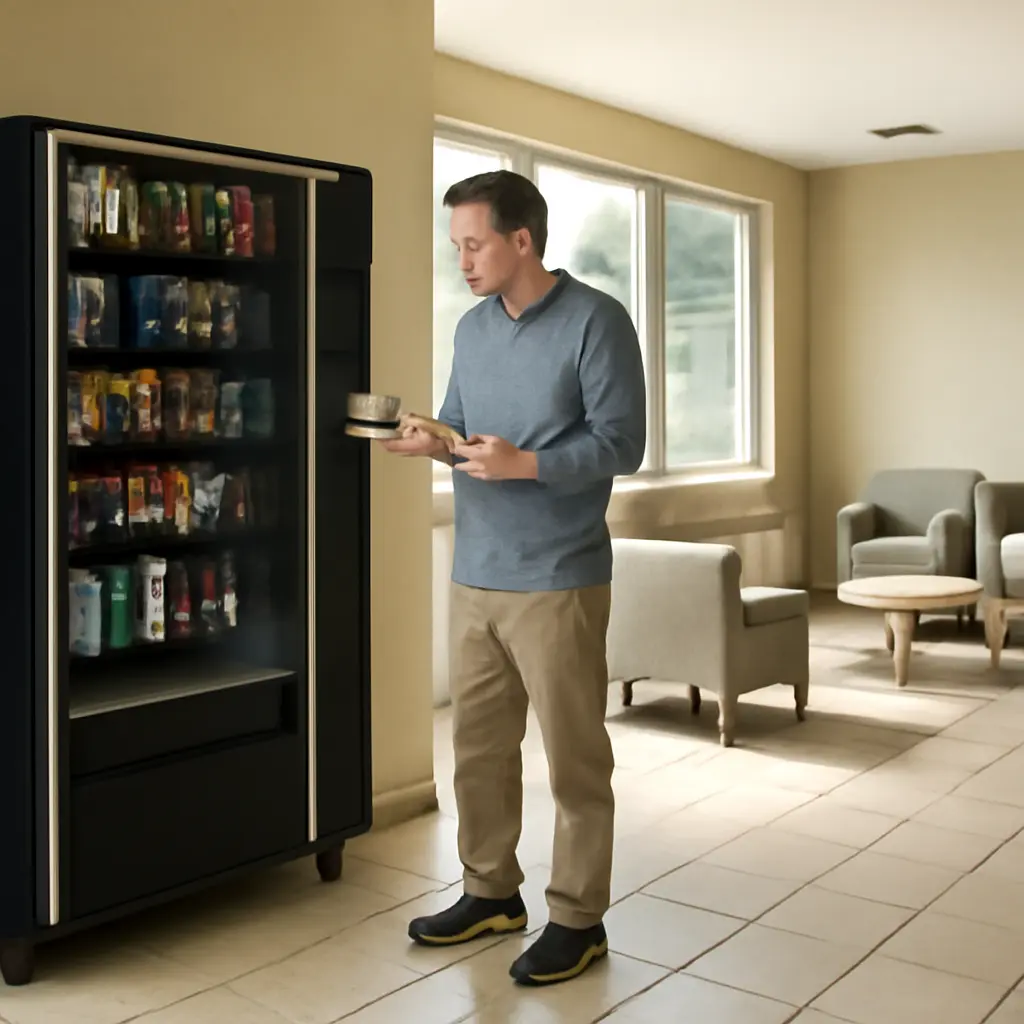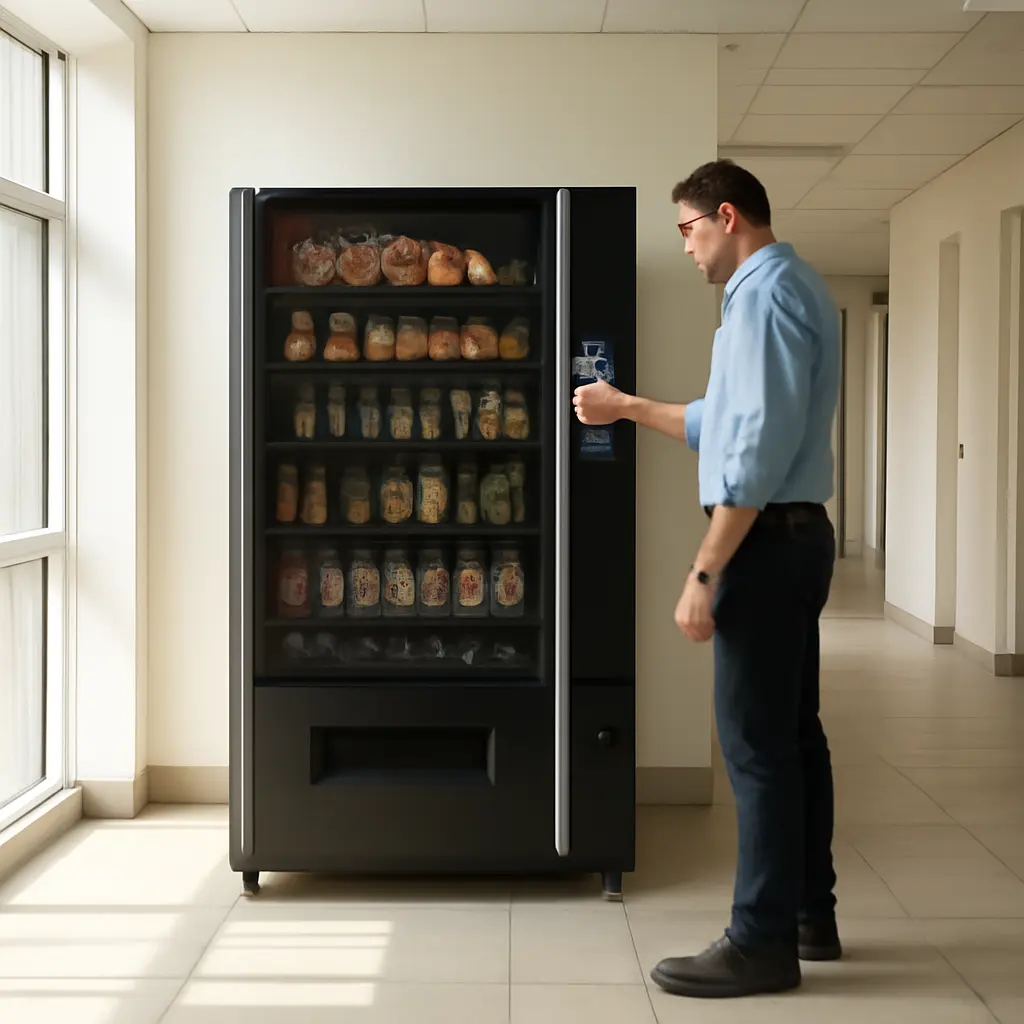
Automated vending dispensing technology is the combination of machines, software, sensors, and payment systems that selects and releases a product without a seller handling each transaction. It is moving beyond the traditional spiral-coil snack machine toward connected, cashless, and sensor-equipped systems that can dispense varied goods, monitor inventory, and report operational data. The shift matters: the National Automatic Merchandising Association (NAMA) estimated U.S. convenience-services revenue at $26.6 billion in 2023, while the U.S. Energy Information Administration reported that commercial buildings account for a substantial share of national electricity use—making reliability, energy management, and efficient replenishment practical concerns. The direction of travel is clearer than any single forecast: more flexible dispensing, richer telemetry, improved payment options, and carefully governed automation.
Connected dispensing systems expand what vending machines can do
A connected dispensing system is a vending unit whose dispensing hardware communicates with software or external services to support sales, monitoring, and maintenance. The National Automatic Merchandising Association describes convenience services as a broad category that includes vending, micro markets, office coffee, and other unattended retail. In practice, the connected system may combine a controller, product-selection interface, payment terminal, inventory sensors, and a network connection. These capabilities turn a machine from a stand-alone cabinet into a remotely observable retail endpoint.
Telemetry and remote management
Telemetry is the collection and transmission of operating data, such as sales, stock levels, temperature, door status, and fault codes. Operators can use it to identify an empty product lane, detect a refrigeration issue, or prioritize a service visit before a location runs out of popular items. The U.S. Department of Energy’s Better Buildings resources emphasize that building energy management depends on measuring equipment performance and acting on the resulting data; vending telemetry applies the same principle at equipment level. Sensors do not guarantee accurate inventory, however: product jams, misreads, and intermittent connectivity can create discrepancies that still require audits.
Cashless payments and digital interfaces
Cashless vending uses card, contactless, or mobile-wallet payments instead of requiring coins or bills. The Federal Reserve’s 2024 Diary of Consumer Payment Choice found that consumers used cash for 16% of payments in 2023, while credit cards accounted for 32% and debit cards for 30%. Those figures are not vending-specific, but they help explain why operators increasingly add tap-to-pay and wallet options. Digital interfaces can also display ingredients, prices, and product choices, though operators need to keep payment systems secure and provide a usable alternative when connectivity or a terminal fails.
Connectivity and digital payments improve visibility and convenience, but the product still has to move reliably from storage to the customer. That requirement is driving changes in the dispensing mechanism itself.
Flexible dispensing mechanisms widen the product range
A dispensing mechanism is the physical system that stores, positions, and releases a selected item. Conventional machines commonly use spirals, gravity-fed columns, or lockers; newer designs add elevators, robotic pickers, and controlled compartments. The best mechanism depends on product size, fragility, temperature requirements, and expected throughput. There is no universal replacement for the coil machine: the main trend is a wider toolkit matched to a wider range of goods.
Traditional coils, conveyors, and gravity feeds
Coil dispensing advances a product by rotating a helix until the item drops into the retrieval bin. It is relatively simple and well suited to packaged snacks and similarly sized goods. Gravity-fed lanes use sloped shelves to move products forward as items are removed, while conveyors carry goods along a controlled path. These approaches remain useful because they are familiar and can support high-volume sales, but product dimensions and packaging affect performance. A missized item may tilt, snag, or fail to fall, so planograms and machine calibration remain important.
Elevator delivery and robotic retrieval
Elevator systems catch a selected item and lower it gently to the pickup point, reducing the impact associated with a free fall. Robotic systems can retrieve products from shelves or bins and may handle packages that are awkward for coils. These designs are appearing in fresh-food, electronics, and workplace markets where product protection or assortment flexibility is valuable. Their trade-offs include higher mechanical complexity, more demanding maintenance, and the need for software to coordinate selection and movement. Operators should compare total cost of ownership rather than judging a system only by its range of products.
Refrigerated, frozen, and controlled-access dispensing
Temperature-controlled vending maintains products within a specified storage range, while controlled-access systems release goods from a locked compartment after payment or authorization. These categories support meals, beverages, medical supplies, and workplace equipment, but they place additional demands on monitoring and compliance. The U.S. Food and Drug Administration’s Food Code sets model provisions for food safety, including temperature control for time/temperature control for safety foods; local adoption and requirements vary. For refrigerated machines, operators need reliable temperature records, alarm response procedures, and a clear plan for products exposed to unsafe conditions.
As machines handle more product types and more sensitive goods, their control systems must coordinate inventory, payments, access, and safety information. That makes software and data architecture central to the next stage of vending.
Software and data make vending more responsive
Vending management software is the platform operators use to configure machines, review sales, track inventory, and manage service activity. Connected systems can support demand-based replenishment, location-specific product selection, and remote diagnostics. These are operational capabilities, not guarantees of higher sales: outcomes depend on data quality, assortment decisions, location traffic, and service execution.
Demand forecasting and inventory optimization
Demand forecasting estimates future sales using historical transactions and other relevant signals. In vending, a useful model can account for seasonality, day of week, location type, and stockouts. Better forecasts can help reduce unnecessary visits and prevent popular products from being unavailable, while perishable inventory may benefit from tighter ordering and rotation. The U.S. Department of Agriculture’s Economic Research Service has documented the scale of food loss and waste across the U.S. food supply; vending operators can contribute to waste reduction by aligning orders with observed demand, monitoring expiry dates, and adjusting assortments. Forecasts should be checked against real-world conditions rather than treated as automatic decisions.
Computer vision and sensor-based verification
Computer vision uses cameras and image-processing software to identify products or interpret customer interactions. Combined with weight, infrared, or shelf sensors, it may help verify that a product was selected or removed and support checkout in open-shelf micro markets. The technology can reduce some friction, but errors may arise from occlusion, similar packaging, lighting, or sensor drift. Privacy is also important: operators should minimize collection of identifiable data, disclose camera use, secure recordings, and set retention limits consistent with applicable law and policy.
Predictive maintenance and service planning
Predictive maintenance uses equipment data to estimate when a component may need attention, rather than relying only on fixed schedules or breakdowns. Temperature trends, repeated motor errors, and payment-terminal faults can help technicians prioritize work. The U.S. Department of Energy identifies operations and maintenance as important to building-system performance; the same logic applies to vending fleets, where a small fault can stop sales or compromise stored goods. Predictive alerts are most valuable when operators connect them to spare-parts availability, technician workflows, and measurable response targets.
Smarter software and mechanisms can improve service, but they also raise questions about cybersecurity, accessibility, energy use, and the economics of upgrading established fleets.
Deployment priorities shape the technology’s future
A successful vending deployment is one that matches equipment capabilities to customer needs and operating constraints. The International Energy Agency reports that buildings account for around 30% of global final energy consumption, making efficient equipment and operating practices relevant beyond the vending sector. For operators, a practical assessment should include energy use, payment reliability, product protection, accessibility, service coverage, and the lifetime cost of hardware and software.
Energy efficiency and refrigerant management
Energy-efficient vending reduces electricity use through improved insulation, lighting, compressors, controls, or operating schedules. Refrigerated machines are particularly important because cooling runs continuously and performance depends on ambient conditions and maintenance. The U.S. Environmental Protection Agency’s ENERGY STAR program provides specifications and product information for efficient commercial equipment, including qualifying vending machines. Operators can compare certified models, maintain door seals and coils, and use energy-management settings where appropriate. Refrigerant choices also matter because some refrigerants have high global-warming potential; equipment selection and servicing should follow applicable environmental regulations.
Accessibility, reliability, and cybersecurity
Accessible vending enables people with different physical, sensory, and cognitive abilities to select and retrieve products. Clear interfaces, reachable controls, readable displays, and unobstructed pickup areas all contribute. In the United States, the Department of Justice’s ADA Standards for Accessible Design establish accessibility requirements for covered facilities and elements; operators should assess the applicable rules for each site and machine configuration. Connected equipment also needs security measures such as software updates, strong authentication, network segmentation, and limited data access. A payment-enabled machine is part of a broader digital environment, so security responsibility extends beyond the cabinet to vendors and service providers.
Pilot programs and measurable return
A pilot program tests a technology at a limited number of locations before fleet-wide deployment. Operators can compare transaction completion, stockout frequency, spoilage, service visits, energy consumption, customer feedback, and payback period against a baseline. For example, a hospital may test refrigerated meal vending near a night-shift work area, while a university might trial cashless machines in buildings with limited staffed food service. The comparison should account for location differences and total costs, including connectivity, payment fees, software subscriptions, maintenance, and replacement parts.
Conclusion: dispensing technology is becoming a connected service
Automated vending is progressing from basic product release toward connected dispensing systems, flexible mechanisms, and software-led operations. Telemetry and cashless payments improve visibility and convenience; elevators, robotics, and temperature-controlled cabinets expand the products machines can handle; forecasting and predictive maintenance can help operators manage stock and service. The benefits depend on dependable hardware, trustworthy data, energy-conscious choices, accessible design, and strong cybersecurity. Operators considering an upgrade should begin with a small, measurable pilot, consult current safety and accessibility requirements, and compare results with a clear baseline. For further reading, review NAMA’s industry research, the Federal Reserve’s payment-choice data, and the ENERGY STAR vending-machine program.
Sources: National Automatic Merchandising Association, 2024 State of the Industry Report, https://www.namanow.org/; U.S. Energy Information Administration, Commercial Buildings Energy Consumption Survey, https://www.eia.gov/consumption/commercial/; U.S. Department of Energy, Better Buildings, https://betterbuildingssolutioncenter.energy.gov/; Federal Reserve Financial Services, 2024 Findings from the Diary of Consumer Payment Choice, https://www.frbservices.org/news/research/2024-findings-from-the-diary-of-consumer-payment-choice; U.S. Food and Drug Administration, FDA Food Code, https://www.fda.gov/food/retail-food-protection/fda-food-code; U.S. Department of Agriculture, Economic Research Service, Food Loss and Waste, https://www.ers.usda.gov/data-products/food-availability-per-capita-data-system/; International Energy Agency, Buildings, https://www.iea.org/energy-system/buildings; U.S. Environmental Protection Agency, ENERGY STAR Certified Vending Machines, https://www.energystar.gov/products/vending_machines; U.S. Department of Justice, 2010 ADA Standards for Accessible Design, https://www.ada.gov/law-and-regs/design-standards/2010-stds/