
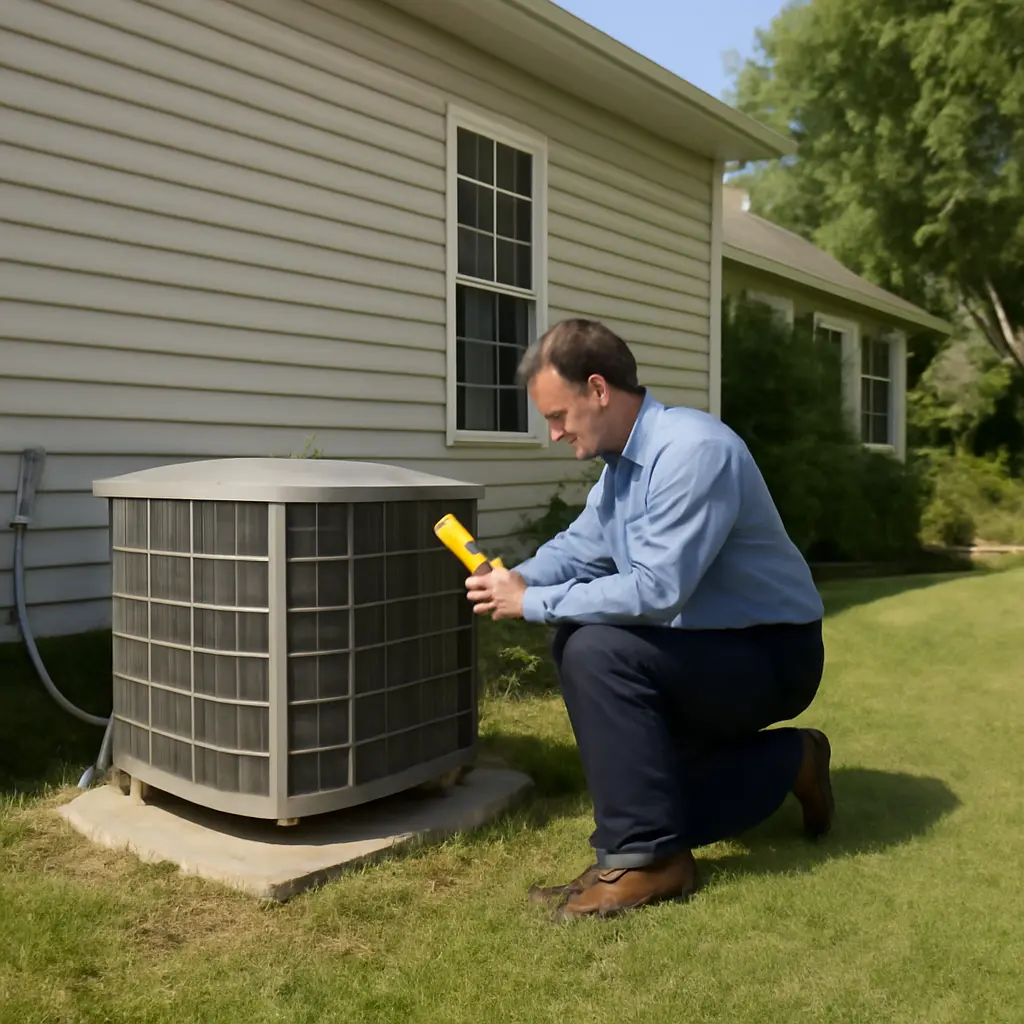
An air-conditioning or refrigeration compressor is the component that circulates refrigerant and raises its pressure so the system can move heat. When it fails, repair may be practical if the fault is limited and the compressor is otherwise sound; replacement is more likely to make sense when the compressor is mechanically damaged, the system is contaminated, or the repair cost approaches the cost of a properly installed replacement. The decision depends on diagnosis, system age and condition, refrigerant type, warranty, and the full installed price—not just the compressor’s part cost. That matters because the U.S. Department of Energy says heating and cooling account for about 52% of energy use in a typical U.S. home, so a poor repair choice can affect both reliability and operating costs.
How compressor failure shapes repair-or-replace decisions
“Compressor failure” is not a single diagnosis. The compressor is the system’s refrigerant pump, but symptoms such as humming, tripped breakers, weak cooling, or a system that will not start can also come from electrical components, wiring, airflow problems, controls, or incorrect refrigerant charge. The U.S. Environmental Protection Agency describes vapor-compression cooling as a cycle in which refrigerant absorbs heat indoors and releases it outdoors; the compressor raises refrigerant pressure to support that cycle.
A technician should establish what failed before recommending a major repair. A capacitor or contactor fault may be repairable without replacing the compressor. By contrast, seized bearings, internal electrical failure, or debris distributed through the refrigerant circuit can turn a compressor job into a broader system repair. There is no universal age or dollar threshold that settles every case: equipment condition, local labor and parts prices, warranty coverage, and the owner’s plans all matter.
Electrical symptoms versus mechanical failure
Electrical symptoms can imitate a bad compressor. A failed start or run capacitor, damaged wiring, a defective contactor, or an overloaded circuit can prevent the compressor from starting or make it trip a breaker. A technician can test voltage, current, winding resistance, and start components to distinguish these faults from internal compressor damage. If the compressor itself tests normally, replacing it would address the wrong problem.
Mechanical failure is more likely when testing confirms that the compressor is seized, has damaged internal components, or cannot perform under operating conditions. The diagnosis should also consider why it failed: restricted airflow, poor heat exchange, incorrect charge, or repeated electrical stress may have contributed. Correcting the cause is essential, because a new compressor installed into the same damaging conditions may fail again.
Contamination and the scope of the job
A compressor burnout can release acidic oil or debris into the refrigerant circuit. In that situation, changing only the compressor may leave contamination behind. Depending on the equipment and the manufacturer’s instructions, a proper repair may require circuit cleaning, a filter-drier replacement, testing, and other related work. Ask the technician to explain what evidence indicates contamination and which steps are included in the written estimate.
This is the key bridge from diagnosis to economics: the decision is not simply “compressor part versus new unit.” It is the cost and risk of a complete, reliable repair compared with replacing equipment that may have other aging components or poor efficiency.
Repair cost, replacement value, and system condition
A repair-versus-replacement comparison should use the total installed cost and the expected condition of the whole system. ENERGY STAR advises homeowners considering replacement to evaluate equipment age, repair needs, comfort, and energy performance rather than focusing on a single component. Its guidance commonly flags heat pumps and air conditioners older than about 10 years for evaluation, but that is a prompt to assess—not an automatic replacement rule.
The technician should provide an itemized quote that identifies the diagnosis, compressor and associated parts, labor, refrigerant work, cleanup or circuit protection, warranty, and any recommended repairs. Compare that with a replacement quote that includes equipment, installation, controls, refrigerant-line requirements, permits where applicable, and commissioning. A low parts-only figure is not a fair comparison with a complete installation price.
When compressor repair is often reasonable
Repair is often worth considering when the failure is isolated, the rest of the system is in good condition, the equipment is relatively young, and the compressor or repair is covered by a meaningful warranty. It may also be sensible when the system uses a refrigerant that remains readily serviceable and the repair does not require extensive work across the refrigerant circuit.
Check what the warranty actually covers. A parts warranty may cover the compressor but not diagnostic time, labor, refrigerant, shipping, or cleanup. The U.S. Federal Trade Commission advises consumers to read warranty terms and understand exclusions; a technician’s estimate should make uncovered charges clear. A covered compressor can still produce a substantial bill if installation labor and related materials are excluded.
When whole-system replacement deserves serious consideration
Replacement deserves serious consideration when the compressor has failed in an older system with other significant defects, when contamination makes the repair extensive, or when the repair estimate is close to the cost of a suitable new system. Replacement may also be attractive if the existing equipment is inefficient, struggles to maintain comfort, or uses a refrigerant whose availability and servicing costs are changing.
Refrigerant rules are an important part of that discussion, but they do not mean every older unit must be replaced immediately. The EPA’s Technology Transitions rules restrict certain higher-global-warming-potential refrigerants in new equipment in stages; existing equipment can generally continue to be serviced under applicable requirements. Ask the contractor which refrigerant your system uses, whether it can be legally and practically serviced, and what future service may cost.
Efficiency claims also need context. The U.S. Department of Energy’s current efficiency standards establish minimum performance requirements for new residential central air conditioners and heat pumps, but actual savings depend on the old system’s condition, the replacement’s rated performance, installation quality, climate, and household use. Request a model-specific comparison rather than relying on a generic promise of a particular percentage reduction.
Choosing a reliable compressor decision
A trustworthy recommendation is supported by measurements, a clear explanation, and options. Before approving a compressor replacement or a new system, ask for the diagnosis in writing and compare the proposed scope with the equipment manufacturer’s requirements. If the repair is expensive or the findings are uncertain, a second opinion can help—especially when one quote recommends a compressor and another recommends replacing the entire system.
Questions to ask the technician
- What tests confirm that the compressor itself has failed, rather than a capacitor, contactor, wiring, or control?
- What caused the failure, and what will be done to prevent a repeat?
- Is there evidence of burnout, acid, or debris in the refrigerant circuit?
- What parts, labor, refrigerant, cleanup, and warranty are included in the repair price?
- What is the complete installed price of a comparable replacement, and what work is included?
- What refrigerant does the system use, and what are the practical service implications?
- Will the proposed replacement be correctly sized and commissioned for the home?
A practical comparison checklist
Compare the choices across the same factors: total cost, remaining system condition, warranty, expected reliability, energy performance, refrigerant serviceability, and how long you expect to stay in the home. A simple comparison table can make the trade-offs visible: list repair and replacement costs, warranty coverage, known defects, and the contractor’s stated assumptions. Avoid treating any single rule of thumb—such as equipment age alone or a fixed repair-cost percentage—as a substitute for a system-specific assessment.
For example, a relatively new unit with a confirmed electrical-start component failure may need a modest repair, not a compressor. An older unit with a confirmed compressor burnout, circuit contamination, and additional failures may justify replacement even if the compressor itself is under a parts warranty. These are decision patterns, not guarantees; the documented diagnosis and complete quote should decide the case.
Conclusion: make the decision from evidence, not pressure
Compressor repair is most compelling when the failure is isolated, the system is otherwise healthy, and the full repair is reasonably priced and properly warranted. Replacement becomes more attractive when compressor damage is extensive, the refrigerant circuit is contaminated, several other components are near failure, or a new system offers a better long-term fit. Because cooling and heating are a major share of household energy use, installation quality and system performance deserve as much attention as the equipment price.
Ask for test results, a written scope, warranty details, and a complete replacement comparison. If the recommendation is unclear or the financial stakes are high, get a second opinion from a qualified HVAC contractor before committing.
Sources: U.S. Department of Energy, “Heating and Cooling,” https://www.energy.gov/energysaver/heating-and-cooling; U.S. Environmental Protection Agency, “The Basic Refrigeration Cycle,” https://www.epa.gov/section608/refrigeration-cycle; ENERGY STAR, “When Is It Time to Replace?,” https://www.energystar.gov/saveathome/heating-cooling/when-it-time-replace; Federal Trade Commission, “Warranties,” https://consumer.ftc.gov/articles/warranties; U.S. Environmental Protection Agency, “Technology Transitions,” https://www.epa.gov/climate-hfcs-reduction/technology-transitions; U.S. Department of Energy, “Central Air Conditioners and Heat Pumps,” https://www.energy.gov/eere/buildings/central-air-conditioners-and-heat-pumps
